In response to recent COVID-19 concerns, we are wanting to assure our patients that we are taking the recommended precautions provided by the CDC. Please use the provided link for more information about our updated procedures. Read More

Close
×

Would you like to switch to the accessible version of this site?

Go to accessible site Close modal window

Don't need the accessible version of this site?

Hide the accessibility button Close modal window
Accessibility View Close toolbar
Yancey Eye Center

303 Harris Industrial Blvd. Suite 7

Vidalia, GA 30474 US

912-537-4400

Open mobile navigation
  • Home
  • Patient Info
    • Online Forms
    • Payment Options
  • Services
    • Contact Lens Exams
    • Eye & Vision Exams
    • Hard to Fit Contacts
    • Computer Vision
    • Sunglasses
    • Diagnosis and Treatment of Eye Disease
  • Eyeglasses
    • Frame Selection
    • Sunglasses
  • Contacts
  • About Us
    • Meet the Optometrist
    • Meet the Staff
  • Technology
  • Contact Us
  • Vision Plan
  • Community Content
    • Common Eye Conditions
      • Age-Related
      • Cognitive and Acquired
      • Vision Impairment
      • Injury & Irritation
      • Eye Lids
      • Changes in Appearance
    • Contact Lenses
    • Eye Diseases
    • Eyeglasses
      • Eyeglass Lenses
    • Eye Symptoms
    • How the Eyes Work
      • Basic Visual Skills
    • Pediatric Vision
    • Protecting Your Eyes
    • Visual Rehabilitation
    • Vision Problems
    • What is Vision Therapy
    • Vision Therapy Programs
    • We Can Help With
      • Cataracts
      • Corneal Disorders
        • Disorders
      • Glaucoma
      • Refractive Disorders
      • Adult Strabismus
      • Retinal Disorders
    • Newsletters
      • Glasses & Frames
      • Contacts
      • Tips for Healthy Eyes
      • Conditions That Affect Vision
      • Kid's Vision
      • Amazing, Interesting Eyes
      • Medical Perspectives
  • COVID-19 Information & Guidelines
  • Home >
  • Articles >
  • We Can Help With >
  • Corneal Disorders >
  • Disorders >
  • Keratoconus

Keratoconus

  • Created in We Can Help With, Corneal Disorders, Disorders
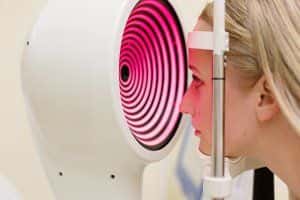
woman undergoing cornea curvature testing

While keratoconus can happen at any stage of life, young people between the ages of 10 and 25 are most likely to develop this disorder. For individuals with keratoconus, their cornea, the clear layer in the front of your eye, gradually thins and begins to bulge outward. Keratoconus typically causes nearsightedness and astigmatism in both eyes.

The first signs of keratoconus are rapid changes in vision that require frequent adjusting of prescription lenses. Other symptoms include increased sensitivity to light, eyes strain and irritation, halos around lights at night, headaches and an incessant urge to rub your eyes. Eventually, the corneas become noticeably cone shaped.

Keratoconus is the most common type of corneal dystrophy, or degenerative corneal disorder. It affects one in every 2,000 Americans, according to the National Eye Institute.

Diagnosis

Many symptoms of keratoconus are similar to those of other corneal disorders, especially during the onset of the condition. This makes keratoconus difficult to diagnose.

Nonetheless, to diagnose keratoconus, ophthalmologists use a slit lamp to inspect your cornea at the microscopic level. Telltale signs of keratoconus include corneal thinning, an iron-colored ring around the cone-shaped cornea, stress lines and scarring at the top of the cone. Your eye doctor will also use instruments and lights to measure the curvature of your cornea.

Causes and Risk Factors

Researchers are not exactly sure why some people develop keratoconus. Leading theories center on genetics, environment and hormones. Some scientists have noted a slightly higher chance of developing keratoconus if a family member has it, but this correlation has not been proven with absolute certainty. Possible environmental causes include allergies that lead to excessive eye rubbing or poorly fitted contact lenses. Some researchers hypothesize that keratoconus is related to the endocrine system (the collection of glands that secrete certain hormones), because the onset often happens at puberty and worsens during pregnancy.

Treatment

Usually, the cornea stabilizes, so vision can be corrected with glasses or contacts. But between 10 and 20 percent of people with keratoconus will have more severe problems that require an alternative form of treatment, such as the following

Corneal Crosslinking. Healthy corneas keep their shape because cross-linked collagen fibers serve as supports. Corneal collagen cross-linking (CXL) involves saturating the cornea with riboflavin drops and activating them with an ultraviolet light. This strengthens the cornea by increasing the amount of collagen cross-linking. While CXL doesn’t cure keratoconus, it can arrest the progress of the disorder.

Intacs Surgery. Your eye doctor may suggest inserting Intacs, extremely thin plastic semi-circles. These flatten the cornea, improving vision. You may or may not still need to wear prescription lenses after Intacs surgery.

Corneal transplant. If keratoconus progresses until the cornea is too thin or scarred to tolerate contacts, your ophthalmologist may recommend a corneal transplant. According to the National Eye Institute, this operation is successful in more than 90 percent of those suffering from advanced keratoconus.

If you are experiencing signs of keratoconus, call us so we can diagnose your vision condition and suggest an appropriate plan of action for your visual needs.

  • Common Eye Conditions
    • Age-Related
    • Cognitive and Acquired
    • Vision Impairment
    • Injury & Irritation
    • Eye Lids
    • Changes in Appearance
  • Contact Lenses
  • Eye Diseases
  • Eyeglasses
    • Eyeglass Lenses
  • Eye Symptoms
  • How the Eyes Work
    • Basic Visual Skills
  • Pediatric Vision
  • Protecting Your Eyes
  • Visual Rehabilitation
  • Vision Problems
  • What is Vision Therapy
  • Vision Therapy Programs
  • We Can Help With
    • Cataracts
    • Corneal Disorders
      • Disorders
    • Glaucoma
    • Refractive Disorders
    • Adult Strabismus
    • Retinal Disorders
  • Newsletters
    • Glasses & Frames
    • Contacts
    • Tips for Healthy Eyes
    • Conditions That Affect Vision
    • Kid's Vision
    • Amazing, Interesting Eyes
    • Medical Perspectives

Yancey Eye Center Vision Care Plan

In house vision plan offer for patients without vision insurance. Request information using the form or call us at (912)537-4400.

Error!

    Featured Links

    Click to find out more

    • Services

      We strive to provide complete care for our patients/ learn more about all the services we provide.
      Learn More
    • Request An Appointment

      We will do our best to accommodate your busy schedule. Request an appointment today!

      Schedule Now
    • Online Forms

      Our patient forms are available online so they can be completed in the convenience of your own home or office.
      View Forms

    Office Hours

    Our Regular Schedule

    Monday:

    8:00 am-12:00 pm

    1:00 pm-5:00 pm

    Tuesday:

    8:00 am-12:00 pm

    1:00 pm-5:00 pm

    Wednesday:

    8:00 am-12:00 pm

    1:00 pm-5:00 pm

    Thursday:

    8:00 am-12:00 pm

    1:00 pm-5:00 pm

    Friday:

    8:00 am-2:00 pm

    Saturday:

    Closed

    Sunday:

    Closed

    Location

    Find us on the map

    Testimonials

    Reviews From Our Satisfied Patients

    • "Yancey Eye Center is the best at what they do and make you feel right at home."
      John Doe Vidalia, GA
    • "Dr. Yancey and staff deliver the highest level of professionalism and customer care I have ever seen.We are very fortunate to have such a excellent center for our eye health care needs. Thank you and continue the great work!"
      Philip Sassos

    Featured Articles

    Read up on informative topics

    • March Newsletter: Top Signs You Need to See an Optometrist

      Do you need to make an appointment with the eye doctor? ...

      Read More
    • March Newsletter: How Dehydration Affects Your Eye Health

      Do you know how dehydration affects your eyes? ...

      Read More
    • February Newsletter: How to Prepare for an Eye Exam

      Are you ready for your eye exam? ...

      Read More
    • February Newsletter: What are Eye Floaters and When Should You Seek Treatment?

      Do you know when eye floaters need treatment? ...

      Read More
    • January Newsletter: Why You Should Not Ignore Dry Eye Symptoms

      Are your eyes dry? Find out why you shouldn't overlook your symptoms. ...

      Read More
    • January Newsletter: How the 20-20-20 Rule Can Reduce Eye Strain

      Struggling with eye strain? This simple rule can help. ...

      Read More
    • December Newsletter: The Best Contact Lenses for Dry Eyes

      Need to find more comfortable contacts for your dry eyes? Take a look at these options. ...

      Read More
    • December Newsletter: Daily Habits That Affect Your Vision

      Could your daily habits harm your eyesight? ...

      Read More
    • November Newsletter: Why It's Important to Have an Extra Pair of Eyeglasses or Contact Lenses

      Do you have an extra pair of eyeglasses or contact lenses? ...

      Read More
    • November Newsletter: The Advantages of Rimless Eyeglasses

      Are rimless eyeglasses right for you? ...

      Read More

    Newsletter Sign Up

    Error!

      • Copyright © 2026 MH Sub I, LLC dba iMatrix.
      • Admin Log In
      • Site Map